
TMJ Disorder Treatment in Bodrum, Turkey: A Complete Patient Guide +90 505 707 4848
TMJ disorder treatment in Bodrum, Turkey is something many patients only start researching after weeks or months of unexplained jaw pain, clicking, or headaches that a dentist eventually links back to the temporomandibular joint. If you’ve been told your symptoms may be TMJ-related, or you’re trying to understand whether jaw pain, clicking, or difficulty opening your mouth fully could be connected to your dental health, this guide explains what TMJ disorder is, how it’s typically assessed, what treatment options exist, and what to consider if you’re looking into care while in Bodrum.
This is a condition with a wide range of possible causes and severities, so this guide focuses on general, medically responsible information rather than diagnosing or promising a specific outcome for your case.
What Is TMJ Disorder?
The temporomandibular joint (TMJ) connects your lower jaw to your skull, just in front of each ear, and allows you to chew, speak, and move your jaw side to side and up and down. TMJ disorder, sometimes called TMD, refers to a group of conditions affecting this joint and the surrounding muscles that control jaw movement, resulting in pain, restricted movement, or unusual sounds when the jaw moves.
TMJ disorder is not a single condition but a spectrum of related problems, ranging from muscle tension around the jaw to issues with the joint’s internal disc or, in some cases, arthritis affecting the joint itself.
Common Signs and Symptoms
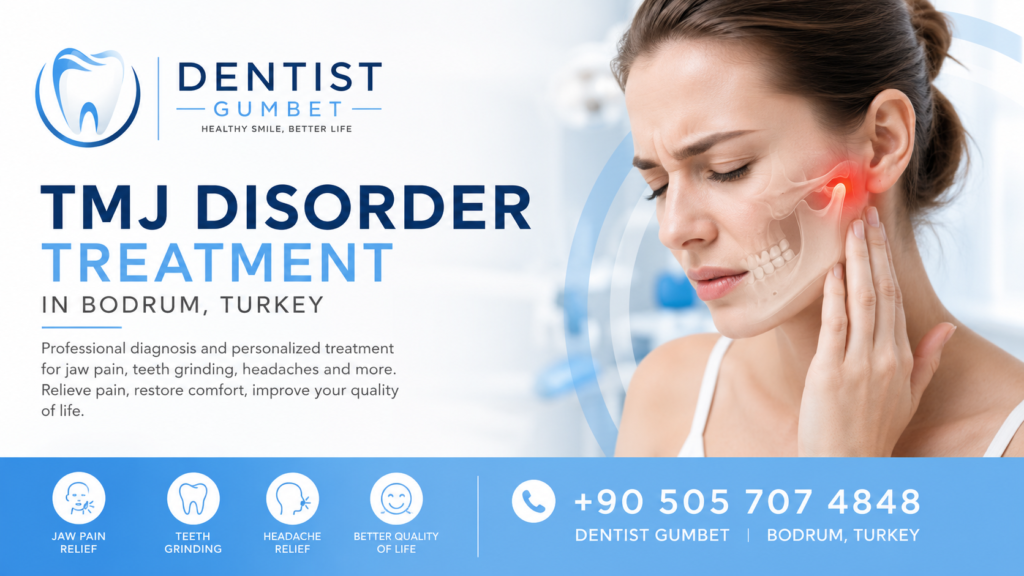
A dentist can only confirm whether symptoms are related to TMJ disorder through a clinical examination, but common signs that lead patients to seek an assessment include:
- Pain or tenderness in the jaw, face, or around the ear
- Clicking, popping, or grating sounds when opening or closing the mouth
- Difficulty opening the mouth fully, or a jaw that feels like it locks
- Headaches, particularly around the temples
- Pain that worsens with chewing or wide yawning
- A sense that the upper and lower teeth no longer fit together comfortably
- Earaches or a feeling of fullness in the ear without signs of ear infection
Because these symptoms can overlap with other conditions, including ear or sinus issues, a proper evaluation is necessary to understand what’s actually causing them.
What Causes TMJ Disorder?
There is often no single, clearly identifiable cause of TMJ disorder, and in many cases it results from a combination of factors. Recognized contributors include teeth grinding or clenching (bruxism), jaw injury, misalignment between the upper and lower teeth, arthritis affecting the joint, and muscle tension often linked to stress. In some patients, symptoms develop gradually with no obvious trigger at all.
Who May Be Suitable for TMJ Assessment and Treatment?
Anyone experiencing persistent jaw pain, clicking, restricted movement, or related headaches may benefit from a dental assessment, though the appropriate treatment path depends entirely on what is found during examination. TMJ disorder ranges considerably in severity: some patients have mild, self-limiting symptoms, while others experience more persistent or complex issues requiring a broader treatment approach involving several healthcare professionals. This is why an individual clinical evaluation, rather than general online information, is the necessary next step for anyone with ongoing symptoms.
Consultation and Dental Assessment
A TMJ assessment typically involves a review of your symptoms and medical history, a physical examination of jaw movement and joint sounds, and an evaluation of how your teeth meet when biting down. Your dentist may also ask about teeth grinding, clenching habits, stress levels, and any history of jaw injury, since these are commonly relevant factors. In some cases, imaging may be used to assess the joint itself more closely.
During a dental assessment, factors such as bite alignment, the condition of the jaw joint, muscle tension, and any signs of teeth grinding may all influence what treatment approach is considered appropriate for your specific case.
How Is Treatment Planned?
Because TMJ disorder varies so much between patients, there is no single standard treatment that applies to everyone. Planning depends on the severity of symptoms, the likely underlying cause, and how the condition is affecting daily function such as eating and speaking. In many cases, conservative, non-invasive approaches are considered first, with more involved treatment reserved for cases that don’t respond to initial management.
How Is TMJ Disorder Typically Treated?

Depending on the assessment findings, management approaches that may be discussed include:
- Behavioural and lifestyle adjustments — such as avoiding excessive jaw movement, eating softer foods during flare-ups, and managing stress, which can contribute to jaw clenching.
- Night guards or splints — custom-made devices worn during sleep to reduce the impact of teeth grinding or clenching on the jaw joint.
- Bite adjustment — in cases where misalignment between the teeth is contributing to the problem, correcting this may be part of a wider dental treatment plan.
- Physical therapy or jaw exercises — sometimes recommended to improve muscle function and reduce tension around the joint.
- Pain management — short-term use of anti-inflammatory medication may be advised for symptom relief during flare-ups, under appropriate medical guidance.
- Referral for further evaluation — in cases involving more complex joint issues, referral to a specialist in orofacial pain or oral and maxillofacial care may be appropriate.
Not every approach is suitable for every patient, and your dentist will explain which options are relevant to your specific presentation.
Treatment Timeline
For many patients, initial management with a night guard, bite assessment, or lifestyle adjustments can begin relatively quickly once an assessment has been completed. However, TMJ disorder often improves gradually over weeks to months rather than resolving immediately, and a custom night guard typically requires impressions or scans followed by fabrication time before it’s ready to wear. More complex cases involving significant joint issues may require an extended treatment and monitoring period.
Recovery and Ongoing Management
For many patients, TMJ symptoms are managed rather than “cured” in a single treatment, particularly when grinding or clenching habits are a contributing factor, since these habits often require ongoing management with a night guard or behavioural changes. Mild discomfort when first adjusting to wearing a night guard is common and usually settles within a short period. Patients are generally advised to monitor their symptoms over time and return for follow-up if pain persists, worsens, or new symptoms develop.
How Long Do Treatment Results Last?
Results vary considerably depending on the underlying cause. A night guard can help manage symptoms linked to teeth grinding for as long as it continues to be worn as advised, but it does not address every possible cause of TMJ disorder. Bite adjustments, where relevant, are intended to be a longer-term correction, though ongoing dental check-ups remain important to monitor how the bite and joint respond over time. No treatment can guarantee that symptoms will not recur, particularly if underlying contributing factors such as stress or grinding are not also addressed.
Benefits of Seeking TMJ Assessment
Getting an early evaluation for jaw pain or clicking can help identify manageable contributing factors, such as teeth grinding, before symptoms become more persistent or start affecting daily activities like eating and speaking comfortably. Understanding what is actually driving your symptoms — rather than assuming the cause — allows for a more targeted, appropriate approach rather than generic pain management alone.
Risks and Considerations
As with any dental or medical evaluation, there are limitations worth understanding:
- TMJ disorder can have multiple contributing causes, and it isn’t always possible to identify a single definitive cause
- Some cases require input from professionals beyond general dentistry, such as specialists in orofacial pain
- Night guards and bite adjustments help manage symptoms for many patients but do not guarantee complete resolution
- Persistent, severe, or worsening symptoms should always be re-evaluated rather than managed indefinitely with home measures alone
TMJ Treatment Cost in Turkey
The cost of TMJ-related treatment in Turkey depends heavily on what your specific case requires. A custom night guard involves impressions or scans and laboratory fabrication, while bite adjustment or more involved treatment plans vary based on complexity. Because TMJ disorder covers such a wide range of presentations, an accurate cost can only be provided after a clinical assessment has determined what treatment approach is actually appropriate for you.
TMJ Treatment in Turkey vs the UK
Patients researching TMJ care while considering travel often want to understand how ongoing management would work if ongoing follow-up is needed. Since TMJ disorder frequently requires monitoring over time rather than a single appointment, it’s worth discussing with any clinic — in Turkey or elsewhere — how a night guard fitting is followed up, and how you would seek further advice if symptoms change after returning home.
Why Consider Bodrum for Dental Treatment?
Bodrum’s international flight connections through Bodrum Airport and established visitor infrastructure make it accessible for patients combining dental care with travel. That said, TMJ disorder is a condition best approached through proper clinical evaluation and, where needed, ongoing management, rather than treated as a single-visit holiday procedure. If travel is part of your plan, it’s worth discussing with your dentist how any recommended treatment, such as a night guard, fits around your trip and what follow-up might look like once you’re home.
Your Dental Assessment Journey in Bodrum
While every clinic’s exact process may differ, a typical pathway for patients seeking a TMJ assessment in Bodrum might look similar to this:
- Initial enquiry, describing your symptoms and how long you’ve experienced them
- Preliminary discussion ahead of travel, where possible
- Arrival in Bodrum and a clinical examination of jaw movement, bite, and joint sounds
- Discussion of possible contributing factors, such as teeth grinding or bite alignment
- Agreement on an appropriate initial approach, such as a night guard or further evaluation
- Impressions or scans taken if a custom device is recommended
- Fitting of the device, with guidance on use and what to expect
- Aftercare guidance and advice on monitoring your symptoms
- Ongoing follow-up with your own dentist once you return home
Confirm these steps directly with the clinic you’re considering, since the right pathway depends entirely on what your assessment finds.
Frequently Asked Questions
What causes TMJ disorder?
There is often no single cause. Contributing factors can include teeth grinding or clenching, jaw injury, misaligned bite, stress-related muscle tension, and arthritis affecting the joint. In many patients, more than one factor is involved.
How is TMJ disorder diagnosed?
Diagnosis is based on a clinical examination of jaw movement, joint sounds, and bite alignment, along with a review of your symptoms and history. Imaging may be used in some cases to assess the joint more closely.
Can a night guard help with TMJ pain?
For patients whose symptoms are linked to teeth grinding or clenching, a custom night guard can help reduce the impact on the jaw joint and may ease symptoms. It is not a universal solution, since not all TMJ disorder is caused by grinding.
How much does TMJ treatment cost in Turkey?
Cost depends on what your specific case requires, ranging from a custom night guard to more involved treatment. An accurate cost can only be given following a clinical assessment.
Is TMJ disorder permanent?
Not necessarily. Many patients see improvement with appropriate management, particularly when a clear contributing factor like grinding is addressed, though some cases involve more persistent symptoms requiring ongoing monitoring.
Can TMJ disorder go away on its own?
In some patients, mild symptoms improve without formal treatment, particularly if related to temporary stress or muscle tension. However, persistent or worsening symptoms should be assessed by a dentist rather than assumed to resolve on their own.
Does TMJ disorder always require a specialist?
No. Many cases are appropriately managed within general dentistry, particularly when linked to grinding or minor bite issues. More complex joint problems may warrant referral to a specialist in orofacial pain or oral and maxillofacial care.
Can jaw clicking be a sign of a serious problem?
Clicking alone is common and not always a sign of a serious issue, but when combined with pain, locking, or restricted movement, it’s worth having assessed by a dentist to understand what’s happening within the joint.
How long does it take to get a custom night guard fitted?
This typically requires at least two appointments: one for assessment and taking impressions or scans, and a second to fit the finished device once it has been fabricated.
Should I see a dentist or a doctor for jaw pain?
A dentist is often a reasonable first point of contact for jaw pain, since many contributing factors relate to bite and teeth grinding. If your assessment suggests a broader medical cause, your dentist can advise on appropriate referral.
Request Your Personalized Dental Assessment in Bodrum +90 505 707 4848
If you’re experiencing jaw pain, clicking, or difficulty with normal jaw movement, the next step is a proper clinical assessment rather than relying on general information alone. Contact Dentist Gumbet to discuss your symptoms and ask about current availability. Because TMJ disorder varies so much between patients, an individual evaluation is the only reliable way to understand what may be contributing to your symptoms and which approach may be appropriate for you. You can find contact details on our contact page, and read about previous patient experiences on our patient reviews page.